

In this week’s installment of Parts That Don’t Suck, here are a few things that make it easier to focus on riding rather than screwing around with crappy gear. As I mentioned in an earlier piece, I ride a KLR650, which is technically an “adventure bike.” But then again, riding, especially in Arkansas, always seems to be an adventure.
If you got a $10 head, buy a $10 helmet.
One of the things about Arkansas is the lax… or rather, lack of helmet laws, and the people who insist on riding without them. I guess that’s their call. Me, I like my head, and I’ve done enough time in EMS to know that even a minor crash without a full-face helmet usually doesn’t end well.
But it’s more than just a safety thing. It’s about comfort, too. Even a speck of dirt, or in my case a bird, at 60+ mph will get your attention. Not to mention the hearing loss from wind noise.
This time around, I wanted a full-face helmet with an integrated sun visor, like you’d find on a fighter pilot’s helmet. I got tired of screwing around with sunglasses, especially riding into a low-angle sunset. Tinted visors are fine until it gets dark, which is exactly when you don’t want one on a country road.
That narrowed things down to just a handful of options. Only a few manufacturers make them that I trust to protect my brain housing group. It’s a short list.
I ended up with the Shoei GT-Air 3. You get what you pay for with helmets. I’ve always leaned toward Shoei. They put serious effort into engineering their helmets, and I’ve seen firsthand how well they perform on the track.
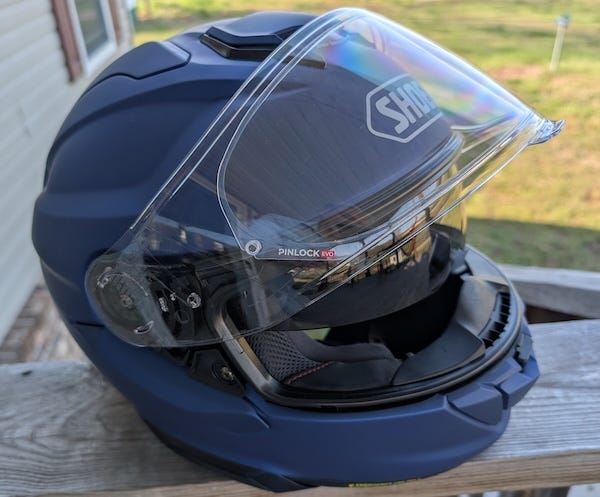
Shoei got a lot of things right. Ventilation and the chinstrap are both done properly, and the helmet feels solid. At about 3.8 pounds, it doesn’t feel heavy at all. I also like that their website offers plenty of accessories and replacement parts, so you can set the helmet up the way you want.
Pro-Tip: You can spend a lot more on custom paint schemes. I’m not trying to look like I belong at Laguna Seca. I bought the basic model.
One thing I didn’t expect, or even know about, was the Pinlock® system. It’s a secondary inner lens that mounts inside the face shield and creates a sealed air gap, which keeps it from fogging up. If you’ve ever ridden in cold or wet conditions, you know how fast a visor can turn useless. This one doesn’t.
I’ve seen similar setups on snowmobile helmets for years, but never on motorcycles.
The helmet came with the insert. Easy-peasy to install, and once it’s in, it just works. No sprays, no wiping with your glove, no screwing around.
And that’s exactly the kind of thing that makes this helmet not suck.
Back Road Equipment Slider Rear Rack
One of the problems with riding motorcycles is that you need a way to carry stuff. In spite of what they say about the KLR650, “that you can fix most things with a rock,” you still need to carry tools, not to mention first aid gear and maybe a rain suit.
The stock rear plate was absolutely useless for attaching a bungee cargo net, and I wasn’t about to spend a lot on Kawasaki’s side cases. By the time you’re done, you’re into it for real money. So I looked for something simpler.
Luckily, the folks at Back Road Equipment had a much better solution. They make a slider rear rack system that solves the problem without overcomplicating it. It’s a pretty cool design, if you ask me. You can secure a Pelican case to it, lock it in place, and still remove it easily when you need to.
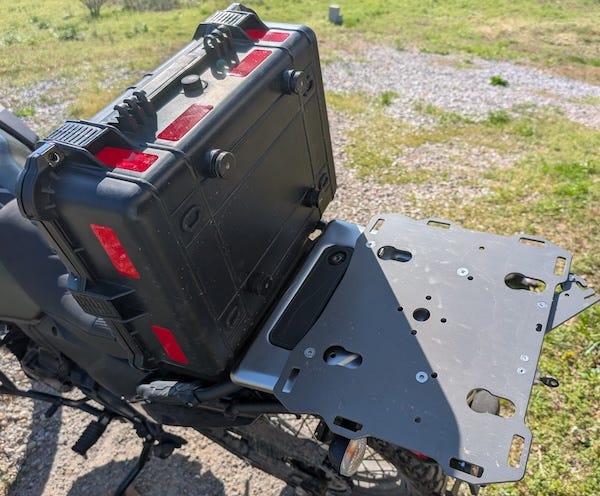
The best part is that it costs just a little over $150, and you don’t have to dish out big bucks for a Pelican box. A $40 Harbor Freight clone works just fine, and you can always step up to a larger one if you need to.
One more thing about the Harbor Freight case. I don’t know who thought it was a good idea to plaster it with that many stickers and labels (Dante probably had a special circle set aside just for them), but I spent over an hour with solvents getting them off.
Installation is straightforward. Drill four holes in the case, install the slider pucks, and don’t forget a little silicone to keep it watertight.
You might find that after removing the Kawasaki stock rear plate, a set of alignment drifts comes in handy for aligning the slider plate.
One more thing before I move on: Back Road Equipment’s customer service was great. The owner called me, helped straighten out my order, and shared a few installation and usage tips.
How about a Light Switch That Doesn’t Suck
When I bought the bike, I got a great deal on Kawasaki’s LED auxiliary lights. The lights themselves are reasonable (did I say I got a good deal). The stock switch on the dash, however, is an unbelievably bad user experience. They stuck it up on the cowling next to the gauges, where it’s awkward and flat-out unsafe to reach.
I don’t know what Kawasaki was thinking. This doesn’t feel like something the core engineers would sign off on. More likely some regulatory requirement turned it into a piss-poor design.
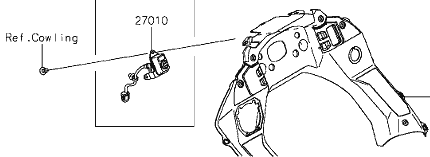
So I did what I always do. I got out my tools and modified it to make it work right.
A much better place for the switch is right next to the light and horn controls on the left handlebar, where your thumb can hit it without taking your hand off the grip.
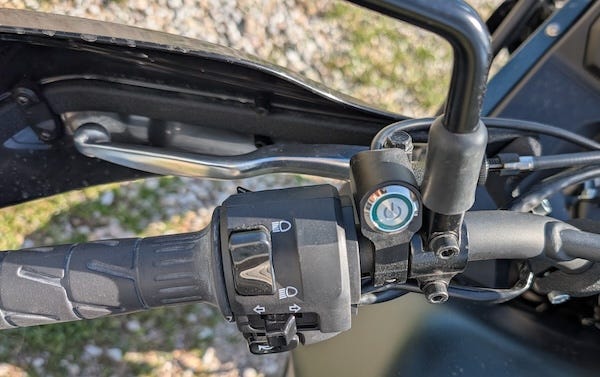
After a few minutes of digging around online, I found exactly what I needed, a simple handlebar-mounted switch. It was even illuminated.
This would have been a five-minute job with some hand tools and a soldering iron, if it weren’t for the wonky way Kawasaki mounted their switch. I had to remove a good chunk of the cowling just to get to the screws they hid behind the switch assembly. But I persevered, and after a few knuckle scrapes, Kawi’s design was just a faded memory.
Make It Your Own
Half the fun of owning a motorcycle is making it your own and setting it up the way you like. That’s how you end up with something that’s actually yours.
Mine just happens to have a pissed-off bunny sticker on it. But that’s me.
As I say in each of these pieces, there are no sponsorships here. Don’t ask for one. No affiliate links. No favors. I’m pretty sure most of these companies have never heard of me, and that’s fine. I’m writing about these parts because they earned their place in my shop by working, not because anyone asked or paid for it.
If you like building things, and sometime doing a better job than the manufacturer, you’ll probably like the rest of what I write. Sharing it helps real people find the work. The algorithm can go take a hike.
I like them too. It's a good helmet. I just couldn't find one with the drop down visor.
Once you find a helmet brand that fits w the features you need you tend to stay with it.
I've used Arai since the 80s for both road and dirt. My kids were in Arais when they got old enough. Funny as they are out and about, buying their own gear and still go w Arai.
I'm a Shoei fan as well