

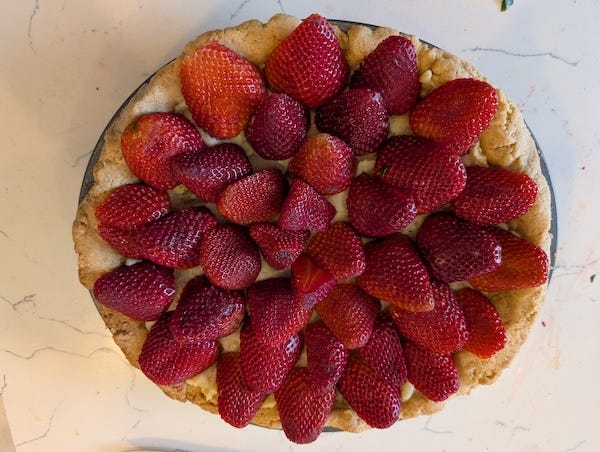
I had a guest visit the other day, and I asked what their preference for dessert might be. They suggested strawberry rhubarb pie. Unfortunately, rhubarb was out of season, so that idea was off the table.
Instead, I went with what I had on hand and put together a Fresh Strawberry Custard Pie. It turned out to be a real hit and didn’t leave much in the way of leftovers.
The combination of a simple butter crust, vanilla custard, and fresh strawberries worked beautifully. Most of my recipes are improvisation anyhow.
I’m sharing the recipe here partly because friends asked for it, and partly so I have it written down somewhere sensible. I’ve learned that if I don’t write it down, it’s lost forever.
So this is both a recipe and a small act of documentation for future me.
Pie Crust Ingredients
This is a derivative of the crust I used in my Apple Pie project.
One thing I did change this time was the flour. For this batch I used flour made from Azure Market Organic Soft White Wheat Berries.
We picked up a grain mill from Amazon a while back and started grinding and sifting our own flour. Fresh-milled flour behaves and tastes a little different than store-bought flour. It has a slightly nutty flavor and a bit more character. After grinding, we sift the flour to remove some of the coarser bran so the crust stays light rather than heavy.
You can substitute Bob’s Red Mill Organic Unbleached White All Purpose Flour if you don’t want to go through the process of grinding and sifting your own flour.
2 1/2 cups, organic ground white flour
1/2 teaspoon, Sea Salt
1 tablespoon, Granulated sugar
5–6 tablespoons ice water
Cut the butter into small ⅜" cubes using a pastry cutter. Combine the flour, sugar, salt, and butter in a bowl and work it together with the pastry cutter until the butter is broken into small pieces.
Avoid the food processor if you can. It works, but using a pastry cutter is just as effective and a lot easier to clean up afterward.
Add the ice water a tablespoon at a time, mixing gently with a fork or pastry cutter.
What you’re aiming for is a coarse, crumbly mixture with little pea-sized bits of butter coated in flour. That texture is what produces a tender crust.
If the dough starts looking smooth or pasty, you’ve gone too far and overworked it. The goal is for the dough to just come together, not turn into a uniform paste.
Occasionally I’ll put the mixture in the refrigerator or freezer for a few minutes to keep the butter cold before continuing. Keeping the butter firm helps the crust bake up tender and flaky.
When you are ready, put some flour down on your work surface and roll the dough out just thick enough to line the pie tin. At that point I put the prepared pie tin into a large Ziploc bag and placed it in the refrigerator until I finished preparing the custard.
Blind Bake the Crust
The crust was blind baked. I lined it with parchment and filled it with “pie weights,” in my case a jar of old black beans. The point is to weigh the dough down so it doesn’t bubble or shrink while the fat melts and the structure sets.
Roll the dough and line the pie tin with the crust.
Cover with parchment + pie weights or beans
Preheat to 350°F
Bake 20 minutes at 350°F
Remove the weights and parchment
Bake again uncovered 10–15 minutes more
optional - beat one egg white and brush a thin layer on the hot crust
Put it back in the oven 2 minutes
Let the shell cool 20–30 minutes before adding custard.
Prepare the custard
For the custard I used the same formula from my Fruit Tart project.
3 tablespoons flour
2 tablespoons arrowroot
½ cup granulated sugar
¼ teaspoon sea salt
2 eggs (fresh from my chickens)
2 cups pasteurized milk
1 tablespoon unsalted butter
1 vanilla bean, split and scraped
Zest of one lemon and one orange, with a little juice from each
A small amount of gelatin, bloomed and added later for extra set
In a medium bowl I whisked together the flour, arrowroot, sugar, salt, and eggs until it looked smooth and lump-free.
In a saucepan I heated the milk and butter with the lemon and orange zest and the scraped-out vanilla bean (pod and all) just until it was steaming but not boiling.
Temper the eggs. I slowly drizzled a ladle of the hot milk into the egg mixture while whisking like mad. The goal is to bring the eggs up to temp gently so they don’t scramble later.
Then I poured the warmed egg mix back into the saucepan with the rest of the hot milk, still whisking. This is also a good time to fish out the vanilla pod.
I cooked it over medium heat, stirring constantly, until it thickened enough to coat the back of a spoon, about 170 to 175 °F if you check. Don’t let it boil hard or you’ll destroy it.
Turn off the heat.
For extra insurance, I bloomed a little gelatin in cold water, then stirred it into the hot custard until fully melted.
I scooped the custard into a glass bowl and pressed plastic wrap directly onto the surface to keep a skin from forming. Let it cool on the counter for a while, then place it in the refrigerator for 1–2 hours until it is cool to the touch and fully set, roughly below 70 °F, before filling the pie.
Assemble the Pie
Once the custard is fully chilled and the pie shell has cooled, it’s time to assemble the pie. Spoon the custard into the baked pie shell and spread it evenly with a spatula. The filling should be thick enough to hold its shape but still spread smoothly.
Level the surface and return the pie to the refrigerator for about 20–30 minutes to firm up slightly. This helps keep the strawberries from sinking when you arrange them.
Once the custard is set, the pie is ready to decorate with fresh strawberries. I sliced the tops off, cut the berries vertically, and arranged them in circular layers, working from the outside toward the center.
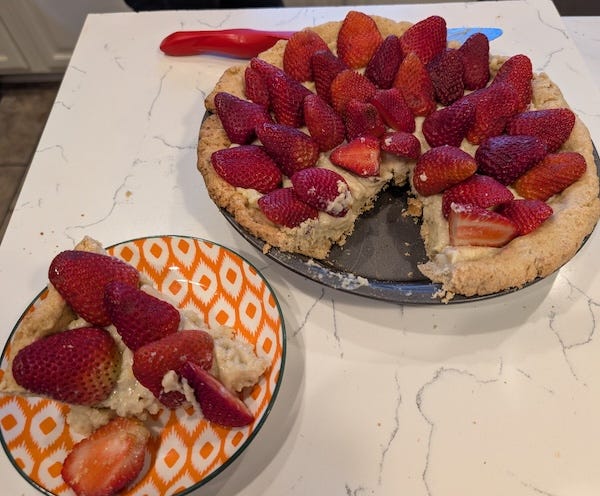
That’s all there is to it. A simple crust, a straightforward custard, and a pile of fresh strawberries arranged on top.
It started as a substitute for strawberry rhubarb pie, but it turned out to be a pretty good dessert on its own. Sometimes cooking works that way. You aim for one thing, and circumstance pushes you somewhere else.
The result was good enough that it’s worth writing down so I can make it again without reinventing it. And if someone else happens to try it and enjoy it too, all the better.
If you care about how things are made and why they’re built the way they are, you’ll probably like the rest of what I write about. Sometimes I even write about things that are yummy.
Hitting like and sharing helps real people find the work. The algorithm can go pound sand.