

MEAN WELL DRC Security Power Supplies
Mean Well Enterprises was founded in Taiwan in 1982 by Jerry Lin, during the early expansion of personal computing. According to the company, the original brand name was taken from Lin’s English dictionary. “Mean well” was intended to convey the idea of having good intentions. The company’s initial work focused on power supplies for IBM-compatible clone systems, where machines were assembled from off-the-shelf parts rather than built by a single vendor.
Their power supplies became known for tolerating unstable input power, handling load changes cleanly, and operating continuously without intervention. As Mean Well later shifted fully into industrial power supplies, they gained a reputation for conservative ratings, consistent behavior across product lines, and long-term availability.
In building my irrigation system, I had to battle with dirty rural power, voltage spikes, brownouts, and outright power failures. I needed a power supply that would stay up through short disturbances, provide status signals when line power dropped, and keep the system running long enough to shut down cleanly instead of crashing.
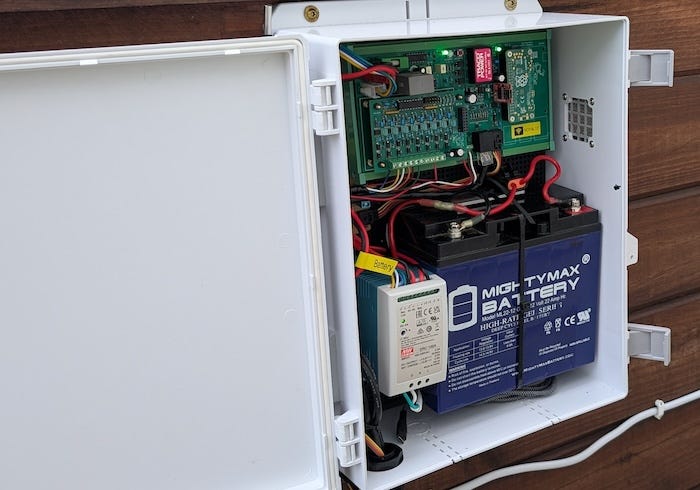
That led me to the Mean Well DRC series, specifically the DRC-100, which is designed as a security power supply for alarm and access control systems that must continue operating through brief power interruptions. The DRC-100 is not just an AC-to-DC regulated power supply. It also functions as a battery charger and a backup power controller in a single unit. This lets me run the system from line power when available while keeping a battery charged and ready to take over when the grid fails.
The wide 90–264 VAC input range and tolerance for brownouts are a good fit for my rural environment, as are the convection cooling and temperature ratings. On top of that, the DRC includes basic protections like overload and over-voltage protection, battery low cut-off, and reverse polarity protection.
The DRC series comes in 13.8 V and 27.6 V versions, with power ratings of 40 W, 60 W, and 100 W. For many systems, the smaller units are sufficient. In my case, I was powering a Raspberry Pi and a few irrigation valves at once, and the 5.0 A available from the 60 W unit at 12 V was cutting it a little close, so I chose the 100 W model for additional current margin.
The DRC units also provide two signals, AC OK and BATTERY LOW, which behave like dry relay contacts and do not source any current. In my article Smart Power Switch and Shutdown for Raspberry Pi Farm Projects, I describe how I wire these signals into the controller so the software knows when line power has dropped and when the battery is nearing its limit. That allows the system to finish anything in progress and shut down cleanly.
After switching to the DRC, the irrigation system has stayed up and running without interruption, which solved the power problems outright.
TRACO Power DC/DC Converters
Once the incoming power was stabilized with the DRC, the remaining problem was converting the 13.8 V supply to usable voltages for the Raspberry Pi and control logic. That voltage works well for loads like valves and relays, but it is outside the safe input range for directly powering logic.
This is where TRACO Power DC/DC converters fit into the design. TRACO Power is a Swiss manufacturer focused on embedded power components used in industrial, rail, and automation systems where isolation and long-term reliability are expected.
I wanted to use an isolated DC-DC converter to keep the Raspberry Pi power rail from being directly tied to the noisy valve and PWM drive domain. As I describe in my sprinkler valve article, the valves are driven with PWM, which produces fast current transitions and ground movement. That behavior is useful for reducing power in the solenoids, but it is not something I want coupled directly into logic power.
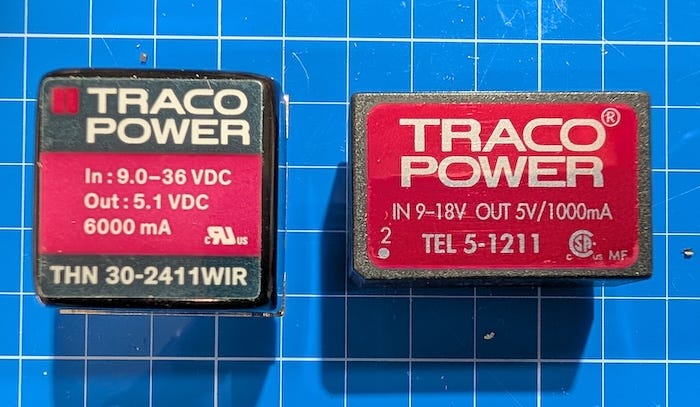
Using isolated DC/DC converters breaks the direct electrical path between the noisy valve and PWM drive domain and the Raspberry Pi logic rail. That keeps ground movement and switching noise from being injected into the logic supply and lets me control where, and if, the grounds are tied.
My board is laid out to accept either of two TRACO Power DC/DC modules, depending on what the system is doing and the environment it is running in. For low-power operation with a Raspberry Pi Zero 2 W, I use a TEL 5-1211. When more power is needed, such as when running a Raspberry Pi 5, I can install a THN 30-2411WIR without changing the rest of the design.
I chose the TRACO converters because they are designed as embedded power components rather than general-purpose buck regulators. They provide full isolation, tolerate wide input voltage ranges, and are rated for continuous operation. Several of the parts I use also carry railway ratings, indicating tolerance for electrical transients, temperature extremes, and long service life.
These parts aren’t cheap, and they cost significantly more than generic DC/DC modules. But in a system that lives outdoors, drives inductive loads, and is expected to run unattended, the cost of me going out there to fix power instability problems is higher than the price difference.
Pololu Voltage Regulators
Not all of my projects require isolated regulation. In parts of the system where the power domain is already clean and there are no large inductive or PWM-driven loads, a simple non-isolated step-down regulator is sufficient.
I got turned on to the Pololu regulators by a buddy at Apple who also spends his off time coaching kids in robotics competitions and working on model railroads. In that world, parts get abused, wiring isn’t perfect, and things are expected to work anyway.
Pololu Robotics & Electronics is a U.S.-based company founded in 2000 by three students at Massachusetts Institute of Technology, where they developed an infrared beacon system for the 6.270 Autonomous Robot Design Competition. After graduating, they moved the company to Las Vegas for its better climate and lower taxes (imagine my shock). Pololu started with small robotics platforms and motion control hardware and later expanded into compact voltage regulators and other embedded components.
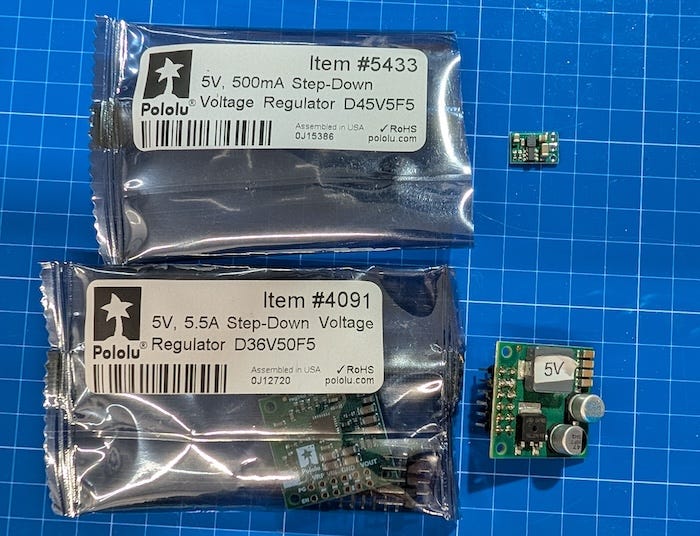
While Pololu makes a wide variety of voltage regulators, two ultra-compact modules that show up repeatedly in my designs are the D36V50F5 (5 V, 5.5 A) and the D45V5F5 (5 V, 500 mA). I’ve used a number of their regulators over the years, and none of them have failed on me yet.
The D36V50F5, and the newer D24V22F5, are well suited for powering a Raspberry Pi from a 12 V or higher supply. They handle the Pi’s load transients and startup currents well, and I’m using one of these in my current automated chicken coop project.
For my AVR-based power switch logic, where idle drain matters more than peak current, I selected the D45V5F5 because its low quiescent current makes it a good fit for always-on control and power-management circuits.
The parts use standard 0.1-inch pin spacing, which makes them easy to prototype with and integrate into a PCB as a submodule.
And as I said at the beginning of the series, there are no sponsorships here. Don’t ask me for one. No affiliate links. No favors. I’m fairly sure most of these companies have never heard of me, and that’s fine. I’m writing about these parts because they earned their place in my shop by working, not because anyone asked or paid for it.
If you like building things and want to know why certain parts get chosen and what actually survives outside a lab, you’ll probably like the rest of what I write. Sharing it helps real people find the work. The algorithm can do whatever it wants.