

This is my 128th article on Substack, and it’s a little different. Instead of farm automation or self-hosting, I'm gonna jibber-jabber about how I became the kind of person who builds those things.
My father was an electrician, and he taught me the trade early. That sparked an interest in electronics that never really went away. We were often involved in remodeling buildings, and I'd scrounge through the discarded electrical parts looking for something I could use.
I was mesmerized by all the cool stuff coming out of the space program and would pore over every copy of magazines like Popular Electronics that I could get my hands on. Whatever money I made working with Dad usually ended up at the local Radio Shack, buying parts for my next project. I wasn't interested in owning gadgets. I wanted to know how they worked.

Naturally, some of those projects got me into trouble now and then. I remember learning at an early age that you could bounce a laser off a window and recover conversations from the reflected beam. To an electronics geek in the 1970s, that was pure magic.
Interestingly enough, I never got into ham radio until much later. It required studying theory and passing an exam. As a teenager, I wasn't very interested in following someone else's curriculum. If something caught my imagination, though, I'd happily disappear down the rabbit hole until I understood it. I'd rather be building something, or occasionally blowing it up.
High School and Computers
My first real encounter with computers came in junior high school. My math teacher happened to be in charge of the computer room, and he let us fool around on the school's IBM 1130. He even taught us a little FORTRAN. Everything was done with punch cards, and it all felt pretty formal. The machine fascinated me, but it was also a black box. You could write programs and use it, but the hardware itself was off limits. It belonged to IBM. It wasn't long before I figured out how to play games on the console, though.
Some of the upperclassmen had moved on to MIT and invited us to come hang around. Around the same time, MIT was running something called the High School Studies Program (HSSP), a program run entirely by students. Once I got on campus, I quickly discovered the hacker culture at the MIT AI Lab.
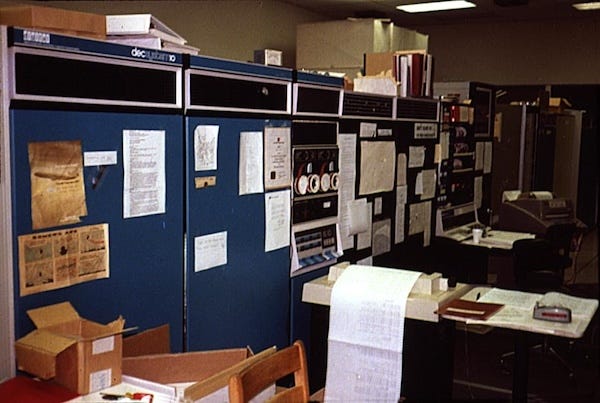
The first thing that caught my eye was a DEC PDP-6, already an old machine by then, running Spacewar! This was long before any of us knew what a video game was.
Then I discovered the terminals. You could walk up to almost any open terminal, log in, and suddenly have access to some of the most advanced computing resources in the world. Unlike the IBM 1130, these weren't machines you were expected to leave alone. You were expected to poke around, read the source code, figure out how things worked, and make them better. If you fixed something, great. If you built something cool, even better.
There was even a room lined with racks of AI Memos, Working Papers, and Technical Reports. If someone was working on something interesting, chances were there was a paper sitting there for the taking. You could grab a copy, head to a terminal, and spend the afternoon learning about ideas that were years ahead of anything being taught in school.
One of my favorites was AI Memo 239, better known as HAKMEM. It wasn’t a polished research paper. It was just a collection of programming tricks, math puzzles, hardware hacks, and other odd ideas that people at the AI Lab thought were worth writing down.
Possibly one of the coolest things I came across was the Knight TV system. Think Macintosh, only a decade earlier. In a world of Teletypes and character-based CRTs, this was something else entirely. Tom Knight built it at the MIT AI Lab in the early 1970s. It gave people real bit-mapped displays, 576 by 454 pixels, driven by frame buffers on a PDP-11 hard-wired into the PDP-10. You could put a pixel anywhere you wanted. That may not sound like much today, but back then it completely changed how you thought about interacting with a computer.
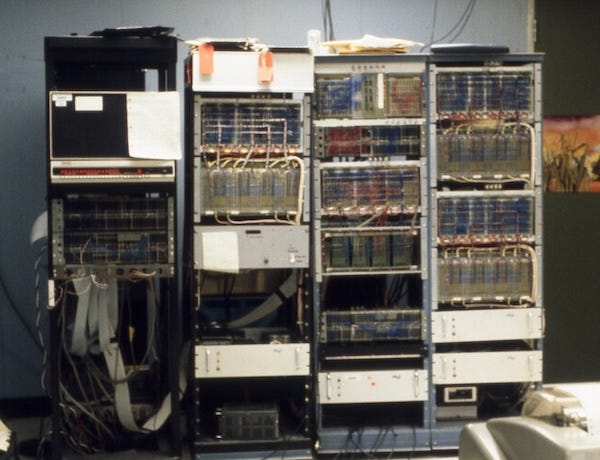
What really fascinated me wasn’t just what the system could do. It was the racks of electronics and the wire-wrapped boards. Ordinary people had built this machine because they wanted the computer to do something new. Looking at it, I couldn’t help thinking, “I want to build something like this myself.”
My timing couldn’t have been better.
The Homebrew Computer
About that same time, a quiet revolution was taking shape, one that would change the world. Intel had introduced the 8008. For the first time, you could buy the brains of a computer on a single chip.
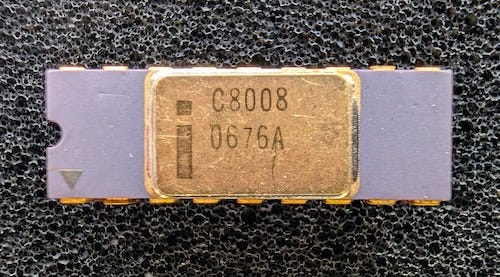
By today’s standards it was primitive. An 8-bit chip running at 500 kHz, only 16 KB of memory, maybe a twentieth of a MIPS. None of that mattered. For the first time, someone like me could actually build a computer at home.
The chip alone cost about forty bucks, a lot of money for a high school kid in 1975, but that was just the beginning. The 8008 was a finicky chip that needed a pile of support logic just to interface with memory. If you wanted it to talk to a serial terminal, assuming you were lucky enough to find a surplus Teletype, that required even more hardware. By the time you added memory, TTL chips, sockets, power supplies, and a cabinet to put it all in, building your own computer was a serious investment.
I somehow managed to get my hands on an Intel MCS-8 User’s Manual. It explained every aspect of the 8008, right down to the timing diagrams and interface logic. I read it so many times the pages became worn and frayed. In fact, I was so absorbed by it that I ended up repeating Latin in summer school. I even brought the manual with me and read it there.
I wasn't the only one thinking this way. Around that time I ran into a fellow named Carl Helmers from Peterborough, New Hampshire, who was doing the same thing. He published a little newsletter called Experimenter's Computer System (ECS). He later went on to start a magazine called BYTE. You may have heard of it.
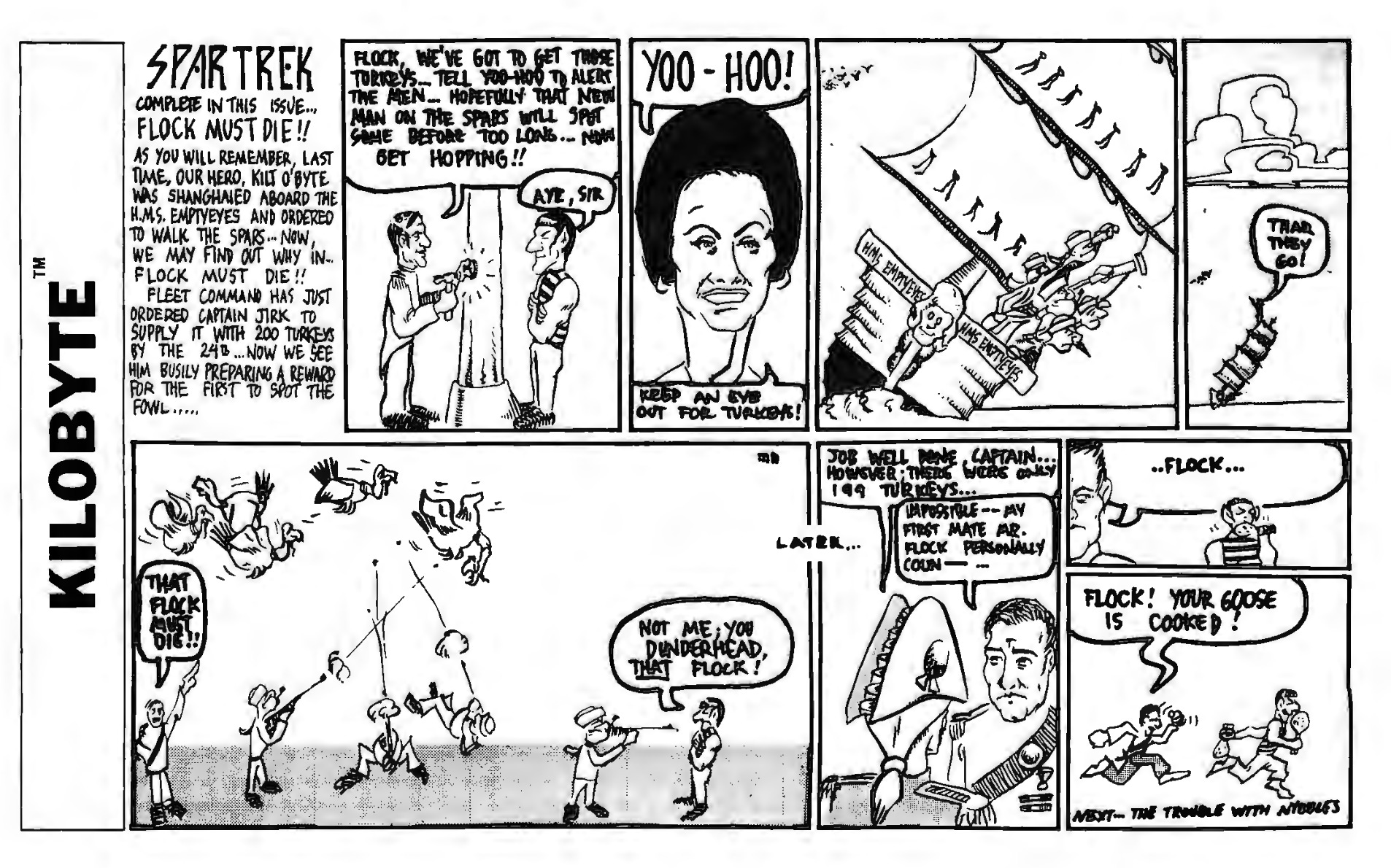
Most people remember BYTE, but fewer remember that it was actually started by Wayne Green, the publisher of 73 Magazine. Wayne was one of the great promoters, and great characters, of the early personal computer industry. After a falling out that cost him control of BYTE, he started a competing magazine called Kilobyte. BYTE promptly trademarked the name, forcing him to rename it Kilobaud. Leave it to Wayne to turn a divorce into a magazine war.
Vector Boards, Wire-Wrapping, and The Mark-8
At first, if you wanted a computer, you designed it yourself. Intel published application notes, but turning an 8008 into a working machine still took serious electrical engineering skill.
Most builders wire-wrapped their circuits on vector boards. A few etched their own printed circuit boards. There were no standards, no motherboards, and no ready-made designs. Every machine was a one-off.
That started to change when hobby magazines began publishing complete computer designs. One that really caught everyone’s attention was Jonathan Titus’s Mark-8, featured in the July 1974 issue of Radio-Electronics.
Calling it a “kit” would be giving it far too much credit. It wasn’t anything like a Heathkit. You didn’t open a box full of carefully labeled parts and follow a step-by-step manual. You ordered a $5 construction booklet from the magazine, and if you were lucky you could buy a set of six bare printed-circuit boards for about $50 from a little company in New Jersey called Techniques.
Everything else, every chip, every resistor, every socket, every connector, every scrap of wire, you had to dig up yourself. Building a Mark-8 wasn’t assembling a kit. It was building a computer from scratch.
The MOD-8: From the Great White North
While the Mark-8 had a following, another machine soon caught my attention. Just as I was getting ready to wire-wrap my own 8008 system, I came across a newsletter from Celetron advertising something called the MOD-8.
So as soon as I could scrape together enough money, I ordered a stack of bare printed circuit boards.
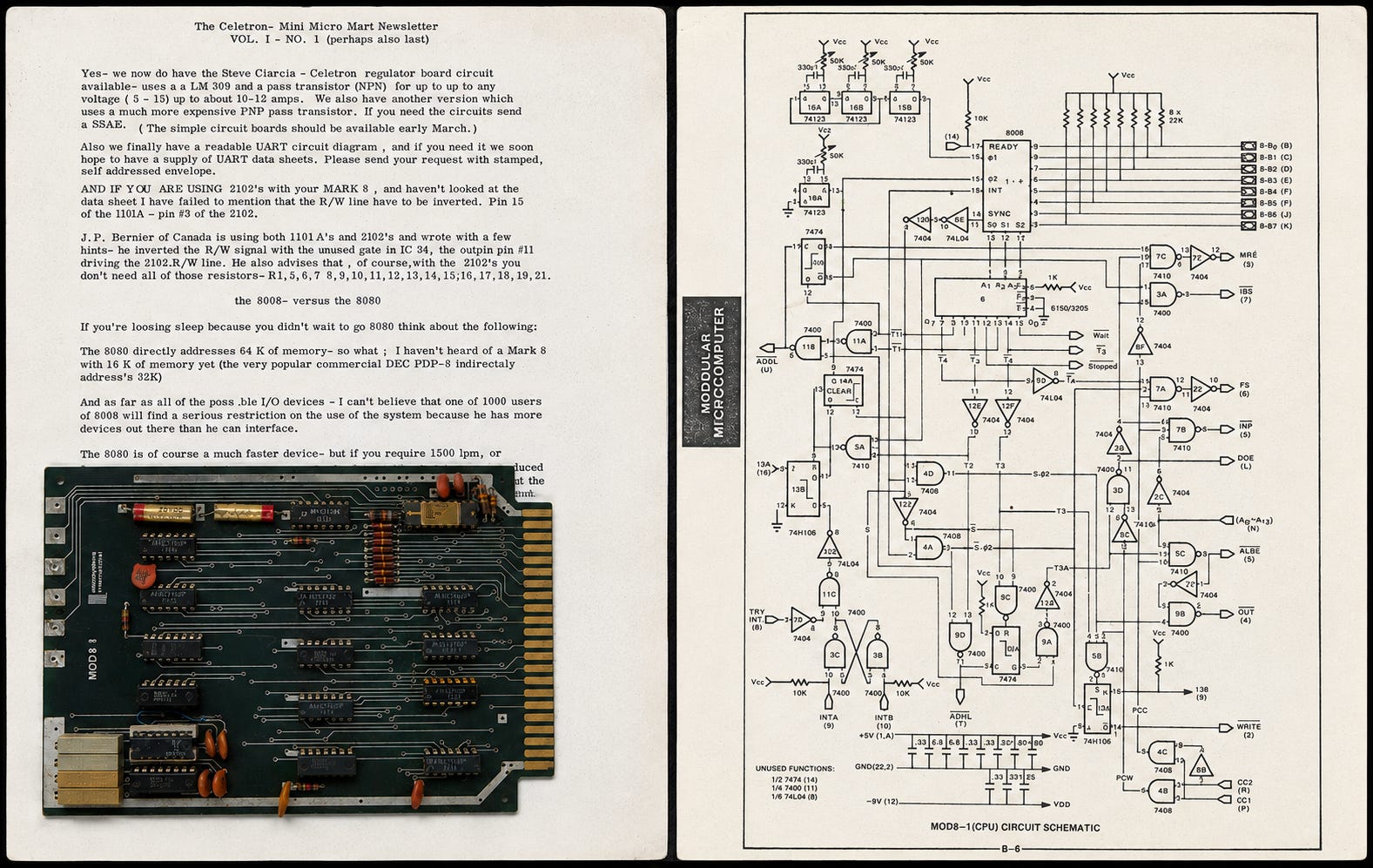
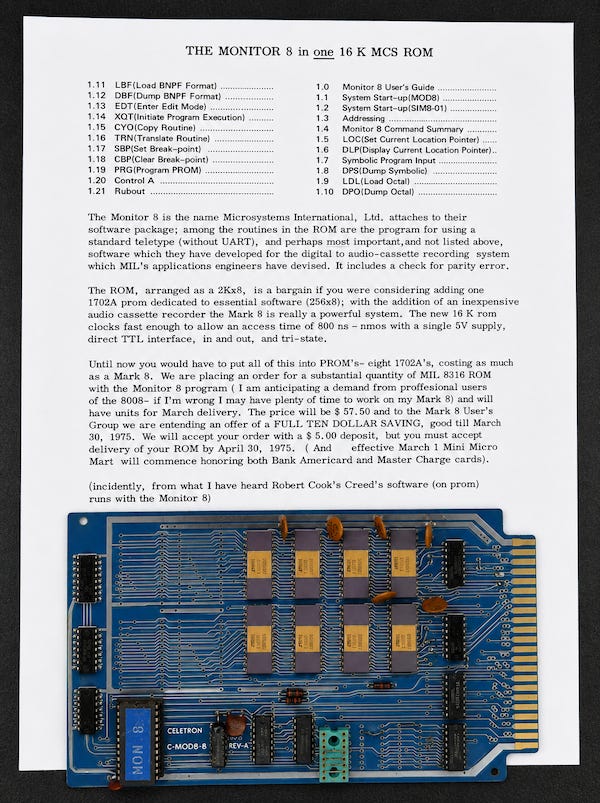
The last piece of the puzzle was the C-MOD8-9, a universal memory board with a whopping 1 KB × 8 of static RAM, sockets for Intel 1702 EPROMs, and a 2 KB × 8 ROM.
The ROM held Monitor 8, a tiny monitor program that completely changed how you used the machine. Instead of flipping switches or hand-entering machine code every time you powered up, you simply connected a serial terminal, or something that looked like an ASR-33 Teletype, to the MOD-8-2 board at a blazing 110 baud and turned the power on. A prompt appeared. Suddenly you could examine and modify memory, load and save programs to cassette, punch paper tape, dump memory, and start programs with simple commands.
It sounds primitive now, but at the time it was a huge improvement. It felt like having a real computer sitting on your workbench. There was just one small problem. To use all of those Monitor 8 commands, I needed a terminal.
The Ins and Outs
That turned out to be easier said than done. The MOD-8 was designed to talk to an ASR-33 Teletype at 110 baud, but I didn't own one, and there was no way I could afford one. In the mid-1970s they were still in everyday service, and even the folks at the friendly local electronics surplus store knew exactly what they were worth.
So whenever I wanted to do any serious work, I had to schlep my project over to MIT, find an unused terminal, and quietly plug into it when nobody was looking. It worked, but it wasn't exactly a long-term solution. So I needed a keyboard, a display, and the electronics to connect the two.
Which brings me back to the local electronics surplus store, Eli Hefferon & Sons. If you were an electronics hobbyist around Boston in those days, you knew Eli. His store was a treasure hunt. You never knew what you were going to find. One week it might be military connectors, the next week DEC modules, oscilloscopes, relays, transformers, or bins full of TTL chips. Half the fun was wandering the aisles. The other half was haggling over the price.
Remember earlier when I mentioned MIT and the High School Studies Program? I somehow talked them into letting me teach a class. Actually, it wasn't really a class. It was just a gathering of homebrew computer geeks who wanted to build computers, trade ideas, and learn from each other.
Well, one day Eli had a pile of surplus Sanders terminal keyboards. They were solid full-travel mechanical units, but useless without new electronics. Someone in our club designed an encoder board that fit them perfectly. We convinced Eli into a group discount and pretty soon half of the problem was solved.
About the same time, Southwest Technical Products SWTPC released the CT-1024. It wasn't exactly a high-resolution display. It could show just 32 characters on each of 16 lines using an ordinary television set. Things were happening.
But I wanted to do something better. I'd been spoiled by the Knight TV terminals at MIT. They were true bit-mapped raster displays with a resolution of 576 by 454 pixels. At one bit per pixel, the frame buffer alone required nearly 32 KB of memory, twice the entire 16 KB address space of the Intel 8008. Not that I could have afforded that much RAM anyway.
As serendipity would have it, I came across a little newsletter called The Computer Hobbyist. In its very first issue, Hal Chamberlin described a homebrew vector graphics display for the Intel 8008. Holy smokes, Batman!
Unlike the expensive raster displays I'd seen at MIT, Hal's design used an ordinary oscilloscope, or surplus radar CRT, to draw crisp vector graphics with almost no memory at all.
I built one, then couldn’t resist improving it by adding my own refresh circuitry to free up the CPU. I actually got it running well enough to win a few science fair awards before it finally let out the magic smoke. Lots of it.
The Homebrew Revolution
Soon it wasn't just me and a few other homebrew computer nuts anymore. Every month seemed to bring another magazine article, another newsletter, or another company selling boards, kits, and parts. What started as a handful of experimenters was turning into a real movement.
Then in January 1975 MITS put the Altair 8800 on the cover of Popular Electronics. Overnight the idea of owning a personal computer went from fantasy to something thousands of people thought they could actually build.
The excitement got so big that people wanted to meet each other. Trade shows and computer conferences started popping up around the country. I made it to the ones in Atlantic City and Philly.
For the first time I was surrounded by people just like me, builders, tinkerers, and hackers who couldn't leave well enough alone. We'd argue about hardware, swap ideas, and spend half the night talking about what we were going to build next.
Before long you could buy complete kits, or even walk into a store and buy a fully assembled computer. What had started as a hobby for a handful of determined builders had become a major industry.
Building It Yourself
Looking back, the homebrew movement wasn’t just about building computers. It was ordinary people claiming the right to understand and shape technology. You didn’t have to wait for some credentialed authority to decide what a computer should do. If you had an idea, you could wire-wrap it together and make it happen.
I never really stopped doing what my father taught me. Figure out how something works. Build one yourself. Don’t be afraid to take it apart and maybe even improve it. That's how you make it your own.
Today I write software, design circuit boards, build open-source systems, and occasionally design an irrigation controller or two. The tools have changed. The curiosity hasn’t.
If you like building the things yourself, you’ll probably enjoy much of what I write about, whether the subject is electronics, software, baking, perfume, or motorcycles. The subject changes without warning, but the questions never do: How does it work? Why was it built that way? And can I build, fix, or control it myself?
Hitting like and sharing helps real people find the work. The algorithm can go pound sand.
Fun read! Starting in about 1958 I was doing the same sort of stuff, but with airplanes... ooooh! I constantly dreamed about flying, and started building those plastic Revell and Monogram models, but they didn't fly! (Well, they sorta did, once each, like a brick.) 10-cent balsa gliders came next, then the rubber-band-powered ROG's that would "fly 1/10th of a mile!" Started cutting and gluing and hacking together multi-engined rubber-powered planes, then graduated to built-up 3-D models covered with "Japanese silk paper." God answered all my prayers one Christmas morning when I was about 8 and I found a Wen-Mac PT-19 U-Controlled gas model powered by a .049 under the tree.
Long story short - I retired 5 years ago from several interesting careers adjacent to or directly involved in aviation. It's been a great life doing what I love and feel passionate about -- just as you have. That is the key to a happy life -- figure out what you love (and it may not even be obvious to you at first), and then DO THAT.
Enjoyed this. How'd you finance it all?