

I honestly don’t know how to write this article. I’m not one to rain on someone’s parade, and if you can make money out of this, good on you. But sometimes you come across something so messed up that you just can’t let it go. This is one of them.
And it fits nicely into my self-hosted, screw-the-ecosystem theme that I’ve been writing about lately.
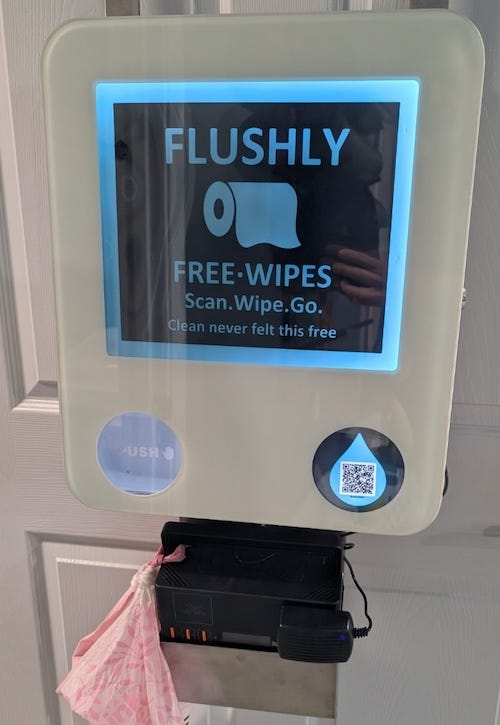
A few days ago, I was at the gym and came across this in the bathroom. Yup, it’s exactly what it looks like. You scan the QR code with your phone, open the web app, enter your contact information, watch an ad, and then you are rewarded, wait for it, with a free certified flushable wipe!
You really can’t make this shit up.
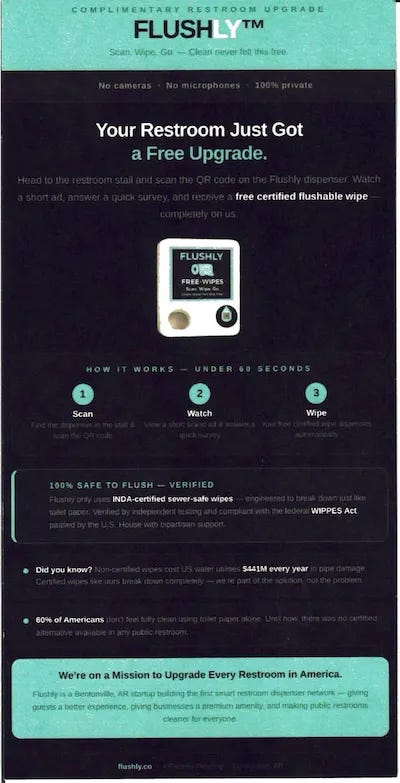
But rest assured, according to the pamphlet, the wipes were independently tested and are even said to comply with the proposed WIPPES Act, which Congress apparently has time to work on instead of, say, strengthening election security.
So how exactly does one get from iPhone to butt wipe?
The Tech Behind the QR code
The pack of squirrels in my brain couldn’t resist doing a little forensic engineering here. So let’s walk through what happens when you scan the QR code. Your phone opens a page hosted by AVA, a Saudi self-service and vending platform:
https://ava.com.sa/app/store/flushly05/BZ20260419flushly05001
That URL identifies the specific Flushly machine and location. Your phone then connects to the vending system, checks that the dispenser is online, and enables the “Get It Free Now” button.
Before dispensing the wipe, the page loads a Typeform survey and asks the user: “Please complete this short survey before using the machine.”
For you code geeks, the site runs on an older jQuery/Bootstrap vending interface and uses Paho MQTT over WebSockets to talk to the dispenser, the same MQTT protocol I wrote about in my home automation article. The newer Typeform code handles the survey and checkout flow. That part looks AI-assisted: more comments, lots of don’t-run-this-twice guards, and a noticeably different style from the older code around it.
So in the end, the QR code is doing a lot more than replacing a pushbutton. It turns a free wipe into a digital transaction involving the machine, the location, the survey, the selected product, and the user’s contact information.
Pay-to-Poo Redux
The whole pay-to-poo shtick is nothing new. Why, the Romans were charging for public toilets nearly 2,000 years ago. And while I’m not sure how many of my readers are old enough to remember, we even had pay toilets when I was a youngin’.
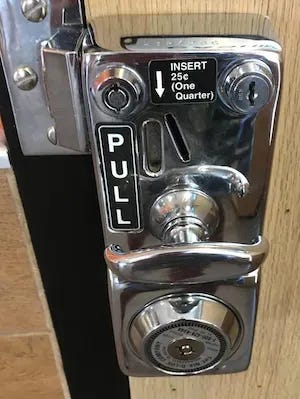
And they might have gotten away with it too, if it weren’t for those pesky kids.
But here we are in 2026, and someone has finally figured out how to turn the whole thing into an advertising platform. I wonder if you need to agree to an EULA or verify your age?
To be fair, this thing is just dispensing a baby wipe, not actual toilet paper. At least for now. But it feels like a slippery slope, in more ways than one. If this is where restroom technology is headed, I may just have to take my own advice and self-host my own toilet paper.
If you are like me and want more control of your digital life, you’ll probably like some of the other stuff I write, whether the subject is electronics, software, baking, perfume, or motorcycles.
Who knows what I will write about next, but the underlying questions are usually the same: How was this made? Why was it built this way? And who gets to control it?
Hitting like and sharing helps real people find the work. The algorithm can go pound sand.
I can't but help think that this is a multi-pronged scam/scheme towards VCs.
First, they get random VC money.
Second, they get contact info to sell many times over.
Lastly, they get the advertising money.
But, I don't think that's where this stops. I think the reason they're relying on the phones, is so they can spoof how many people are actually using it and sell to prospective advertisers that they are actually getting thousands of clicks. It helps push the idea into new bathrooms, too.
I've seen video played on an ESP32. They could have simply played the ad on a screen for less than $10. Only, they wouldn't know how many are actually using it, nor be able to spoof things when it doesn't get traction.
Vinnie, that was easily the funniest, most enjoyable read you've put out in a coon's age. Just because you CAN write something, should you?
Hell yeah!
I was wiped-out by the time I got to the end. Good thing I didn't read this in the bathroom!